


Products

The FRP-2A (Fire Rack Protection) system is used for local monitoring as an early warning of fire danger or serious damage of electronic equipment, associated with the release of smoke and/or increase of temperature inside rack structures in data centers, server rooms, electrical cabinets and other similar facilities.
The FRP-2A system prevents the occurrence of fire and ensures almost 100% continuity of the work process, ensuring continuity of service to data center customers.
The FRP-2A system has been developed for early smoke detection and temperature control in any server cabinet. The goal is that when an incident occurs - release of smoke and/or heat, the system will register these events and identify in exactly which cabinet the problem has occurred.
In this way, timely action can be taken and a potential fire in the cabinet can be prevented. The speed of detection is extremely fast - from 8 to 20 seconds, despite strong ventilation and air exchange in the cabinet.
FRP-2A is the world’s first fire protection system for
each individual server cabinet.
Unique characteristics:
- Continuous monitoring of smoke and heat by analyzing the outgoing air flow in each server cabinet.
- Accurate location of a possible fire in each individual server cabinet.
- Warning of fire occurrence in the server cabinet, as well as its spread to adjacent cabinets and cable routes.
- Preventive temperature control function - programmable threshold for an alarm status for each individual server cabinet.
- Alarming, control and statistics software for each server cabinet as well as the ability to adapt and upgrade according to user applications operating in a cloud/ virtual environment.
- Saving up to 20% on cooling power when configuring each server cabinet based on the temperature statistics measured in the cabinet - a real-time temperature map.
- Activation of light and sound alarm to alert personnel and take action in the event of an incident.
- Verification and confirmation of Alarm/Failure status by the personnel on-site at the server cabinet.
- System failure control - supply voltage, suction system, smoke and heat analysis sensors, all cables and connections to the device.
SYNCHRON-S is the developer, manufacturer and installer of the FRP-2A system.
Download FRP-2A brochure

A key feature of the modern gas fire extinguishing systems are their extremely effectiveness. They extinguish fire in its early stages in the critical seconds before its expansion. The low value of the parameter discharge time and the high value of the parameter duration of protection ensure full control and fast extinguishing of the fire without the possibility of re-ignition.

A key feature of the modern gas fire extinguishing systems are their extremely effectiveness. They extinguish fire in its early stages in the critical seconds before its expansion. The low value of the parameter discharge time and the high value of the parameter duration of protection ensure full control and fast extinguishing of the fire without the possibility of reignition.

Thermographic inspection is an analysis of the heat distribution in the object being to locate problem areas with high temperature, invisible to the human eye. With a thermographic inspection were found concealed damages such as bad electrical connections or terminal connections, faulty switchgear, problem areas in cable channels, damages to motors or other electrical equipment.
The main characteristic of thermographic inspection is early detection of damages, prevention of fire and emergency situations due to an electrical failure. Practice shows that due to the thermographic inspection significant savings are realized, associated with less repair costs, prevent physical and financial losses from fire or emergency interruption of workflow.
Thermographic inspection is a new service of the company SYNCHRON-S made for its customers as part of the overall policy of the company relating to the provision of a set of safety measures to prevent fires and dangerous situations.

Fire detection is a key element in the process fire prevention. The goal of any fire alarm system is to detect fire at the earliest possible stage. The system generates an alarm signal when locates at least one component of the combustion - smoke, flame or heat.
Depending on the fire risk and the specific application, fire alarm systems, which we design and install, are two types - conventional and addressable.
Conventional fire detection systems
Conventional systems detect fire and signal for it, but not localize its place. The detectors are connected to the cable line that goes from the control panel and finishes with a final element. When the detector goes into alarm mode, the system does not know which all of the detectors is activated and changes the operating mode of the entire group. Conventional systems are suitable for small sites, where a possible zone alarm can be crawled quickly and fire can be detected quickly. Detectors are dual mode with "Alarm" or "Normal" status.
Addressable fire detection systems
Detectors and other peripheral devices are located in a loop on the cable line starting from the control panel and finishing in it. This allows full identification of the devices on an individual address. Addressable systems accurately locate the point of origin of the fire according to the address of the detector in alarm.
The most important characteristics of addressable fire alarm systems are:
- Fast response time in case of fire
- No false alarms
- Reliable operation.
Depending on the specific application we use several multi-sensor detectors - optical-smoke, thermal, thermo-differential, flame, Ex-proof or aspiration. Built-in innovative technology for signal processing provides fast detection without risk of false alarms.
Fire alarm panels are interactive with easy-to-use user interface that allows the responsible personnel on site to respond immediately and to take proper action in case of an alarm event. Essential for reliable functioning of addressable systems is the active communication between fire control panel and the address points as well as the ability to program the output states of the system. Fire control panels maintain standard programmable outputs for status "Normal", "Fire alarm", "Fault" and "Pre-alarm". They also support freely programmable outputs, thanks to which the control of fire blocking in case of emergency - elevators, electrical switchboards, ventilation, air conditioning, etc. as well as to activate voice evacuation system and smoke exhaust system can be programmed. Fire alarm system can be easily integrated into a building management system.
Quality and reliability of installed systems
The systems installed by our company meet the requirements of standard SD CEN/TS 54-14 and comply with all applicable local regulations. The equipment is manufactured by the leading global company SIEMENS and is certified by internationally recognized organizations. The installations are performed by trained professionals. Our company is certified for maintenance and servicing of fire protection systems issued by the Ministry of Interior.

A key feature of the modern gas fire extinguishing systems are their extremely effectiveness. They extinguish fire in its early stages in the critical seconds before its expansion. The low value of the parameter discharge time and the high value of the parameter duration of protection ensure full control and fast extinguishing of the fire without the possibility of re-ignition.
Efficiency of gas extinguishing systems is largely due to the mechanism of fire extinguishing. Ii depends on extinguishing agent and goes through several stages - the removal of combustion heat, reduction of oxygen level in the room and breaking the self-sustaining chain reaction of the combustion process.
Depending on the specific application, fire risk and the type of room, gas extinguishing systems which we design and install are based on the inert gases argon or nitrogen or chemical gases FM-200 and Novec 1230 (FK-5-1-12).
Key features of the gas fire extinguishing systems
- Suitable for the protection of people, property and equipment in enclosed spaces
- Suitable for hazardous areas where localization and suppression of fire should be fast, clean and safe
- Protecting the environment , equipment and safe for humans
- Electrically non-conductive, non-corrosive and this makes them suitable for fire protection of areas with active electrical and electronic equipment
- Not causing thermal shock to protect equipment
- Suitable for rooms with high ceilings and low temperatures
- Ability to reach hidden fires
- Suitable fire, wherein the fire is not set or has multiple sources
- Do not leave any particles or residues after release of the agent and does not require the process of cleaning up after fire
- Visibility is not reduced during discharge of the agent
- Efficient over a wide range of fires: Class A, B and fires in rooms with active electrical and electronic equipment
- Typical applications include data centres, rooms with electrical and electronic equipment, telecommunication equipment, libraries, archives, museums and galleries, premises with production processes, warehouses with flammable liquids, transformer rooms and more.

Key requirement for modern gas fire extinguishing agent is their safety for people and the environment. Our gas extinguishing systems have high levels of personal safety. They stop the burning process at high oxygen concentration at which there is no risk to people. Particularly effective are extinguishing systems with Novec 1230 (FK-5-1-12). Novec 1230 (FK-5-1-12) is a new chemical fire extinguishing agent. It has zero potential for ozone layer depletion, short atmospheric lifetime of 3 to 5 days and a global warming potential 1, which meets the latest requirements for clean and safe extinguishing agent. Its low toxicity, combined with the low design concentration provides the widest range of safety compared with other gaseous agents based on hydrocarbons, carbon dioxide or inert gases.

Innovative i FLOW technology for fire suppression with an inert gas
Disadvantages of the gas fire extinguishing systems is the creation of a very high pressure and turbulence during the discharge of the extinguishing agent in the room, which can cause damage to the equipment. i FLOW technology eliminates this risk. The main advantages of the new technology are:
- Eliminates the pressure peak immediately after discharge of the agent - 2,7 times lower peak
- Provides maximum outlet pressure of 60/40 bar at a cylinder pressure of 300/200 bar
- Provides constant flow of extinguishing agent throughout its release without overpressure and turbulence
- Eliminates the need of having a more venting area and exhaust dampers in the room
- Innovative method for matrix design of the cylinders in rows and columns saves resources - lower cost of installation and maintenance, less installation space
Quality and reliability of installed systems
The systems installed by our company meet the requirements of standards NFPA 2001 (2008), EN 15004 and comply with all applicable local regulations. The equipment is manufactured by the leading global companies and is certified by internationally recognized organizations VdS, LPCB, CNPP, UNIIPO, UL and others. The installations are performed by trained professionals. Our company is certified for maintenance and servicing of fire protection systems issued by the Ministry of Interior.

Using water as an extinguishing agent, conventional sprinkler systems are one of the most reliable, economical and safe means of controlling and extinguishing fires. They are environmentally friendly and safe for people.
Sprinkler systems are especially suitable for fire extinguishing Class A (solid combustible substances, smouldering fires, etc.). Typical applications include industrial sites, commercial and administrative buildings, warehouses, offices, underground parking places and others.
As a reliable and economical solution, sprinkler systems have several key features
- Suitable for fire protection of both people and property in enclosed areas
- Respond immediately in the initial stage of the fire, allowing people to safely leave the danger area
- Suppress fire by removing the heat of combustion causing rapid cooling effect in the burning zone
- Operate only sprinkler heads directly above the point of origin of the fire
- No risk of accidental activation - activate only in case of real fire
Automatic sprinkler systems or deluge systems
Depending on the fire risk and the specific application, sprinkler systems, which we design and install are two types - automatic or flooding (drencher) system. Automatic sprinkler systems use sprinkler heads with integrated temperature sensor. When heated by fire, the air is blown to the upper part of the room and heated by conducting the heat sensitive element, the sprinkler head opens and the water flows out. Each spray head is activated independently when the sensor detects that the design temperature (about 68 °C) is reached. With the activation of the sprinkler head, water flows in the pipe network and an alarm signal indicates that the system is in operation.
Flooding systems are usually operated manually or by a signal from the fire alarm panel. It is used as a water curtain to limit the spread of fire towards adjacent rooms or areas with different fire hazards.
Effective solution for fire protection
As a result from sprinkler systems, the following operations are present:
- Full control on fire - stop of the fire growth
- Extinguishing the fire without risk of re-ignition
Quality and reliability of installed systems
- Complies with standard EN 12845
- The equipment is manufactured by world leading companies and is certified by VdS, LPCB, CNPP, UL or ULC
- Installations are performed by trained professionals. Our company has a certificate for installation, servicing or maintenance of fire protection systems issued by the Ministry of Interior and a certificate for installation and maintenance of sprinkler system in compliance with ISO 9001, issued by German organisation VdS.

Fire extinguishing systems with water mist are a new highly efficient extinguishing method with water, which combines the advantages of gas and conventional sprinkler systems. Using water in a new way the water mist systems are:
- Extremely reliable, economical and safe means of fire control and extinguishing
- Environmentally friendly and safe for people, property and equipment
- Extremely fast and efficient extinguishing method
The water mist systems are suitable for a wide range of applications. They are used for fire extinguishing Class A, B and C: cable collectors/tunnels, rotor turbines, transformers, premises with electrical and electronic equipment, chemical plants, computer and telecommunication centres, manufacturing facilities, machine rooms, generators and alternators, warehouses, archives and more.
Technological advantages
Water mist is a specific way to use water as extinguishing agent. Systems use special spray heads with micro nozzles and work under pressure of 80 to 140 bar, thus creating droplets with very small diameter and very high speed. Upon activation of the installation, quick cooling effect occurs, then the micro droplets absorb heat of combustion of about 7 times faster than the conventional sprinkler systems. At the same time rapid and significant reduction of the oxygen content occurs since water mist takes about 1800 times greater volume than the volume of water. Due to that, water mist systems are the most efficient fire protection systems ever, based on water as an extinguishing agent and the only technical solution to specific risk applications. There are three main advantages over conventional sprinkler systems:
- Fast and efficient fire suppression
- No damage to the equipment and no damage to the property
- Fast recovery workflow and operation of facilities
Key features of the water mist systems
- Suitable for protecting people and property as well as complicated and expensive equipment
- Fast fire detection within the first 10-30 seconds when starts effective suppression
- Extremely fast fire suppression within the first 2.5 to 3.5 minutes of its occurrence
- Suitable for local and volume extinction
- Extremely suitable for extinguishing of fast growing fires and deep fires
- Do not emits additional chemicals
- Safe for equipment and property as the agent does not contain aggressive chemical components
- Very effective for extinguishing of flammable liquids
- Use the minimum amount of water from 0.69 l/min/m2, which is about 90% less than the required quantity for conventional sprinkler systems
- Requires less space for the equipment and pipework
- Leave minimal damage after fire
- Pipework is made of stainless steel, which makes it practically forever
- Unlimited resource of extinguishing agent - clean filtered demineralized water
- Economical - low cost of extinguishing agent and no need to replace it periodically unlike gas systems
- The implementation of the system with water mist would significantly reduce the insurance fee for the site
Quality and reliability of installed systems
- Complies with standards NFPA 750, CEN TS 14 972, IMO
- The equipment is manufactured by world leading companies and is certified by VdS, LPCB, CNPP, UL, ULC, FM, IMO
- Installations are performed by trained professionals. Our company has a certificate for installation, servicing or maintenance of fire protection systems issued by the Ministry of Interior and a certificate for installation and maintenance of sprinkler system in compliance with ISO 9001, issued by German organisation VdS.

Fire extinguishing systems with powder are installed in places where there is an increased risk of fire such as rooms or open spaces in the presence of flammable liquids and gases, chemicals or high voltage electrical installations. According to the standards these are so called high-risk areas where conventional methods of fire protection do not provide adequate security. Dry chemical, used in automatic fire systems is an effective and quick extinguishing agent. When sprayed directly on the fire they cause almost immediate extinguishing effect.
Mechanism of fire extinguishing
Main extinguishing effect occurs as a result from chemical intervention on the chain reaction in the combustion process. However, fire extinguishing with powder goes through several stages. Initially the extinguishing agent released in the burning zone forms extinguishing cloud and causes choking effect, displacing oxygen from the burning area. Then the chemical reaction does not allow the free radicals formed in the combustion process to maintain the combustion reaction. Thus interrupt self-sustaining chain reaction while limiting the quantity of heat which is emitted during combustion. The fire extinguishing is fast and without the possibility of re-ignition .
Powder extinguishing systems are conventional BC type suitable for efficient fire suppression in open areas and fires Class B (flammable liquids and gases) and Class C (active electrical equipment). Extinguishing powder is composed of harmless inorganic salts and water-resistant agents. Dry chemical agent is non-toxic, electrically non-conductive and is easy to clean after discharge, requiring only suction or sweeping. Although the components of the fire extinguishing powder are non-toxic, the discharge of a large amount of dust may cause difficulty in breathing during and after release and also to significantly reduce the visibility in the room.
Quality and reliability of installed systems
The systems installed by our company meet the requirements of the standard EN 12845 and comply with all applicable local regulations. The equipment is manufactured by the leading global companies and has the necessary certificates of compliance. The installations are performed by trained professionals. Our company is certified for maintenance and servicing of fire protection systems issued by the Ministry of Interior.

Foam extinguishing systems are well suited for fire extinguishing Class B (flammable liquids) in areas with high fire hazard as warehouses, storage tanks, refineries, chemical plants, etc.
The systems are designed for local suppression of fires burning over large areas of flammable liquids
The foam contains water, concentrate and air. It is resistant to fire, thanks to the concentrate, which contains chemical elements such as fluorine. Fire fighting with foam goes through several stages. Initially, because of its low density compared to the water, the foam creates a surface layer, which stops access of oxygen to the burning surface. However water in the composition of the fire fighting foam rapidly removes the heat and thus stops the combustion. Then there is a chemical reaction in which fluorine interrupts a self-sustaining chain reaction of the combustion process and eliminates the possibility of re-ignition. Depending on the specific application, the systems work with multiple types of foam.
Quality and reliability of installed systems
The systems installed by our company meet the requirements of the standard EN 12845 and comply with all applicable local regulations. The equipment is manufactured by the leading global companies and has the necessary certificates of compliance. The installations are performed by trained professionals. Our company is certified for maintenance and servicing of fire protection systems issued by the Ministry of Interior.

Fire extinguishing systems with reduction of oxygen prevent the occurrence of fire. All other extinguishing methods only apply after fire.
The system is based on controlled reduction of oxygen concentration in an enclosed space by the addition of nitrogen. Oxygen is reduced to a level at which most combustibles can be ignited and the occurrence of fire is impossible.
Systems are the ideal solution to protect the premises where fire would cause loss of valuable property that cannot be restored (data files, documents or artefacts). Typical applications include IT centres, archives, museums and galleries. Systems are very suitable and are the most economical means of fire prevention in large indoor spaces with capacity of more than 2000 m3.

Detection systems for gas and flame are part of the fire and explosion protection of sites with high hazard.
Gas Detection
Systems for gas detection are designed to detect the presence of explosive, flammable or toxic gases emitted as a result from the specific production process or activity. Thus detection systems prevent gas explosions and large fires in hazardous explosive areas. Typical applications include chemical plants, refineries, gas turbines, storages with liquid fuels, public kitchens, laboratories, natural gas boiler rooms, parking areas, aircraft hangars, plants of woodworking, food processing and mining industries. Systems for gas detection can be easily integrated into the fire protection system of the site or may be installed independently.
Flame Detection
Besides the traditional method for detection of smoke and heat used in fire protection systems, there is a growing need for flame detection to protect areas with very high fire risk, where flammable materials are present - liquids, gases or combustible dust. In this case, detection of flame provides a very fast response and a large area of coverage in addition to the traditional methods of detection. Flame detection is implemented with special flame detectors that are integrated into the fire alarm system of the site.
Quality and reliability of installed systems
We use the equipment of leading world manufacturers SIEMENS and SENSITRON for the realization of installations for gas and flame detection. The equipment has been certified by internationally recognized organizations and has ATEX and SIL certificates. The installations are performed by trained professionals. Our company is certified for maintenance and servicing of fire protection systems issued by the Ministry of Interior.

Smoke and heat exhaust systems are an important part of fire protection of the sites.
In case of fire, significant quantities of toxic substances are emitted in the form of flue gases that are extremely dangerous to people. The main purpose of smoke and heat exhaust systems is to ensure the safety of people and safety escape route by taking the toxic fumes out of the room. Furthermore, the smoke and heat exhaust systems help for faster fire suppression as they prevent formation of flammable gases, reduce heat impact on the combustibles in the room, locate and stop fire growth.
Depending on the manner of implementation smoke and heat exhaust systems are two types:
- Natural ventilation systems to remove smoke and heat using smoke and ventilation dampers. The movement of the air is based on temperature and pressure difference.
- Forced ventilation systems to remove smoke and heat using smoke exhaust fans. The movement of the air is based on forced circulation by means of many connected ventilating ducts.
Smoke and heat exhaust systems can be implemented for automatic or manual operation. They strat operating in case of signal from fire alarm system.

The intrusion detection systems protect people and property against robbery, attacks or sabotage. Essential to the effectiveness of the intrusion detection system are the quality and type of detector used. They must provide constant and very large coverage of operation of the system. In the process of implementation of the systems we use a full range of detectors suitable for outdoor or indoor applications, for sites with different levels of risk as well as different environmental conditions - passive infra-red (PIR), mirror optical, dual technology detectors, using combination of PIR/microwave, PIR/ optical or PIR/ultrasonic technology, glass break and seismic detectors, ceiling mount and peripheral protection detectors.
Key features of intrusion detection systems:
- Suitable for both small and large businesses capable of managing up to 464 zones
- Complete coverage of the entire protected area
- Without risk of false alarm and probability of false actuation of the system
- Reliable detection even of very slow movements
- Accurately identify the presence of people
- Ignoring external disturbances or changes in ambient temperature
- Identification of objects and people in their real size, regardless of their distance to the detector
- Possibility to select monitoring zones where only certain parts of the building must be protected
- Identification of moving direction and passing the only movement in the desired direction
- High reliability against the attempt to be "masked" by intruders
- Suitable not only for indoor protection but also for professional perimeter detection in harsh outdoor environments with changing weather conditions
- Ability to visualization of the status of the protected areas - "Disarmed", "Armed", "Alarm" or "Fault
- Easy integration into building management system
Quality and reliability of installed systems
The systems installed by our company meet the requirements of standard EN 50131 and comply with all applicable local regulations. The equipment is manufactured by the leading global company SIEMENS and has the necessary certificates of compliance. The installations are performed by trained professionals.

Video surveillance is a key element of today's complex security systems. The systems we design and install support analogue, hybrid and IP technologies for recording and video surveillance, specialised NVR software for monitoring and adjustment, several types of DVR devices for recording and storing of video information and a variety of cameras - colour and monochrome, indoor and outdoor, day-night, PTZ head cameras for moving objects, monofocal and varifocal, stationary or high-speed dome cameras, vandal resistant and others.
Key features of video surveillance systems
- High speed recording in which even the smallest details of fast moving objects are clearly distinguishable
- Transmission of images without delay and fragmentation of the picture, thanks to a high megapixel recording from IP cameras
- Optimised recording mode depending on the needs of specific application, such as recording only when motion occurs in the area, alarm is activated or recording according to predefined time schedules
- Defining special area covered by the cameras - automatically increases the speed and quality of the recording only when there is a movement in the specific area
- Ability individual cameras or groups of cameras to be individually configured to record according to predefined timetable and to create complex time schedules for a long period of time
- Allow quick finding the desired information using several criteria - by time and date, by specific event, by individual camera or group of cameras
- Define an area of the observed object with the ability to display only the records from this area
- Remote monitoring over LAN and WAN by authorized users
- Reliable perimeter video surveillance of sites with high protection against penetration
Quality and reliability of installed systems
The systems installed by our company meet the requirements of the European standards and comply with all applicable local regulations. The equipment is manufactured by the leading global company SIEMENS and has the necessary certificates of compliance. The installations are performed by trained professionals.

The system controls physical access to premises by allowing access only to authorized persons using a wide range of electronic identification methods. Their functioning is based on three attributes for identification - something you know, such as number or PIN, something you have, such as an access card or tag, something you are, such as a biometric feature, or some combination of these.
The access control systems MCS-2000 which we design and install are universal and can be used everywhere - from small offices, commercial and residential premises to very big sites with enormous traffic, thousands of doors, barriers and elevators - big administrative buildings, governmental and financial institutions, airports, railway stations, malls, hotel complexes, universities, industrial areas and special purpose sites. In the process of their implementation we use control devices, specialized software, several types of reading devices and several types of personnel identificators.
Key functional characteristics of the access control system MCS-2000
- Storing information about access rights to authorized persons
- Recording and archiving all passes through the control points
- Defining different access levels
- Custom access control settings by time schedule
- Maximum security through photo identification of the cardholder
- Automatic regular database backup to an external storage device
- Support door controller in one door mode for small sites
- Ability to manage unlimited number of doors and control access to unlimited number of people in network mode for very large sites and organizations
- Ability to work in a network mode of any distance from the site through the Internet browser
- Integration of software module for time attendance system
- Integration of software module for parking system
Key hardware and software characteristics of the access control systems MCS-2000
- Recording and storing in the controller’s memory 16 384 cardholders/events, archived by date and time, 1240 access levels and 255 time zones
- Communication - LAN/WAN in the existing IT infrastructure, GSM, GPRS or combination of these communications methods
- Personal identificators - contactless cards, magnetic stripe cards, barcode, biometrics
- Readers - RFID, bar code, PIN code, fingerprint
- Data organization MS SQL client - server
- Windows based modular application software with easy and convenient user interface
- Open software and hardware architecture for easy expansion with additional acceess control devices and functions
- Software module for time attendance
- Software module for parking control
- Software module for visualization of intrusion detectors and alarm events from the intrusion detection system
- Software module for visualization of fire detectors and alarm events from the fire detection system
- Sound and light notification in case of alarm event - on individual setting
- GSM and/or E-mail notification in case of alarm event - on individual setting
Quality and reliability of the installed systems MCS-2000
The systems designed and installed by our company are based on our own control panels, which are certified for use in the sphere of security in accordance with standard EN 50133, issued by the Ministry of Defense. The installations are performed by trained professionals.

The software for time attendance system MCS-2000 records and automatically processes the information related to human resources in any organization. It is an integrated management system for personnel worked on schedules and shifts. The system complies with the requirements of the labour legislation and is suitable for use in commercial and administrative offices, as well as in large industrial enterprises. The software is particularly useful for businesses and organizations with a large number of staff and a variety of activities where it is practically impossible for someone to monitor compliance with labour discipline.
Key functional characteristics of the time attendance system MCS-2000
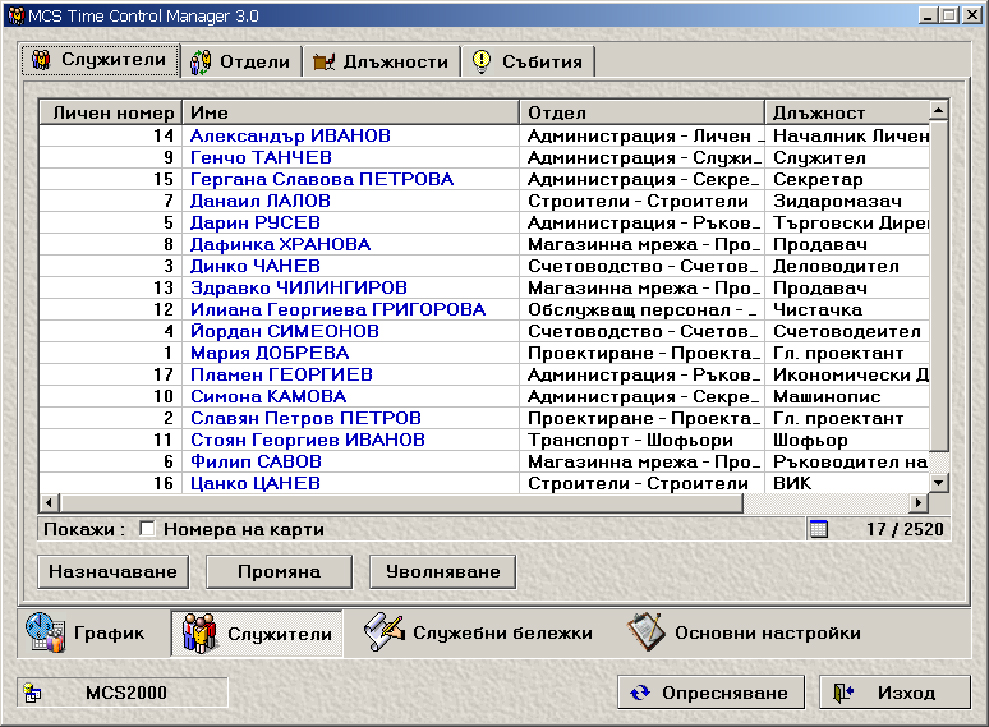
- Configurable to the needs of the organization: The system can be configured according to the particular characteristics of the site and the management strategy of the organization. The employees’ registration is accomplished through a ”personal identification card” on devices, placed on the locations for entry in the site – main entrance, entrance to a subsite or a workshop, or even the workplace itself.
- Planning of the working time: The software package gives a possibility for preparing the working times and monthly schedules of the corresponding departments, both in a centralized way and from the heads of the departments themselves. The working times can be fixed, floating, on schedule, night work, 24-hours shifts, lunch break, etc.
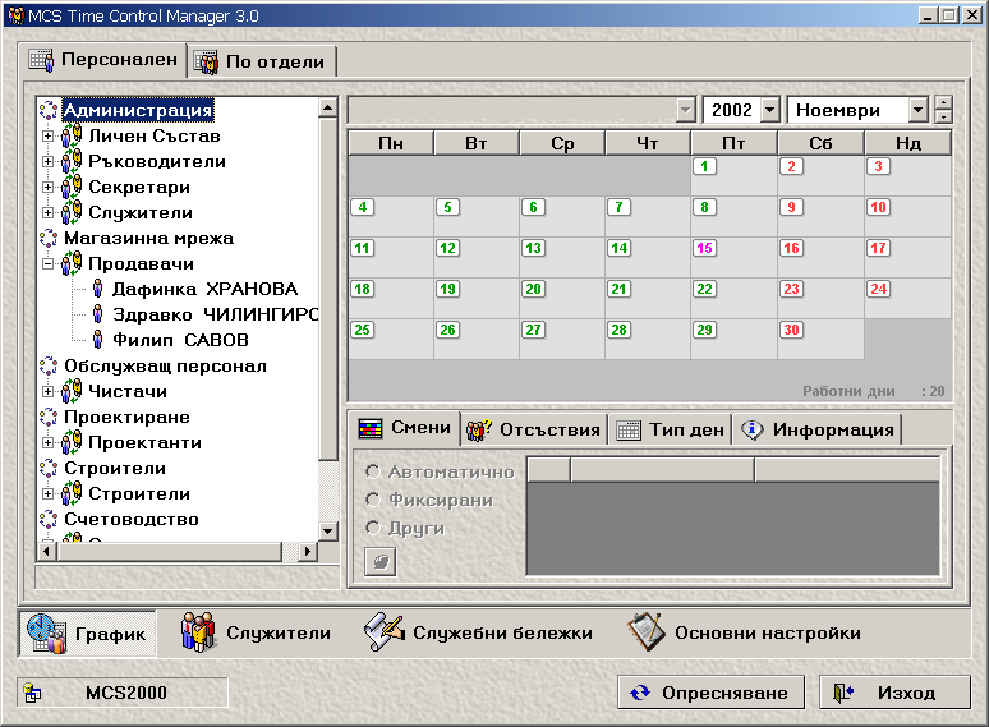
- Everyday control of the working time: The system exerts an everyday control by means of observation of the schedules for working time and presence. The software offers three groups of reports - "Movement of employees'', ''Late employees'' and ''Absent employees'' and they can be used for the whole organization, for a department or for a person.
- Generate reports in a variety of parameters: At any moment can be made report on a selected criterion. The report can be monthly, on selected days of the month, on a given day, for employee, for a department, etc. The reports provides detailed information on the movement of employees, compliance office hours, time of entry and time of exit from the workplace, absences, delays, duration of rest, summary of hours worked during the current or previous month. Absences are recorded in a separate report, thus there is an opportunity to input the type of absence - sick leave, paid or unpaid leave , business trip, compensation and others.
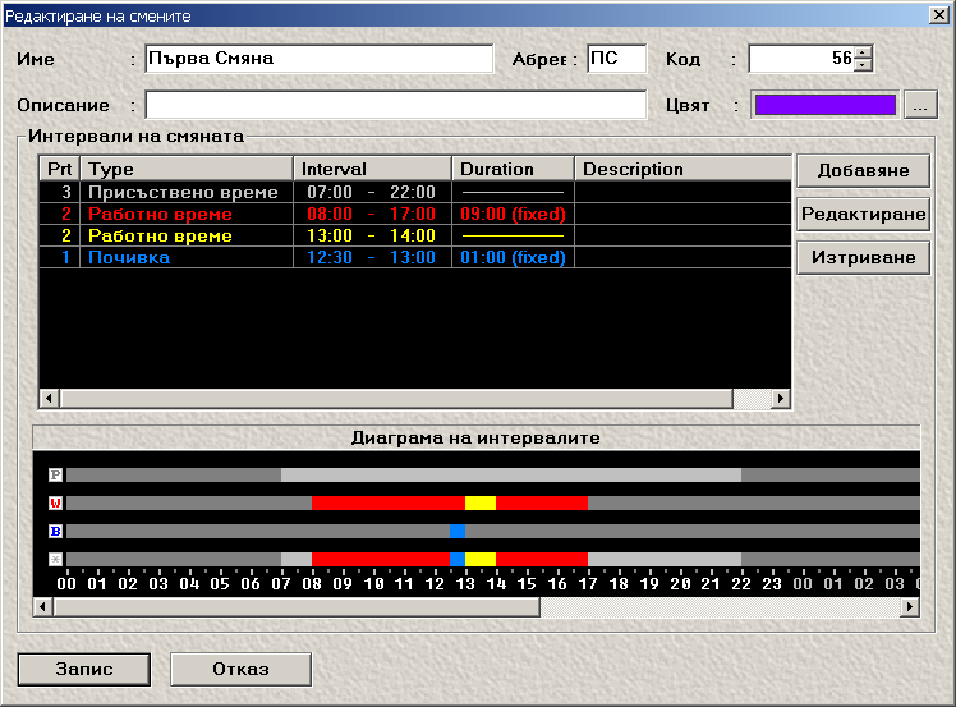
- Complete and independent control of the working process: The information is structured in three hierarchical levels - global indicators for the enterprise, department indicators and finally the detailed information for each employee. Every type of these reports can be used by the respective levels of management in the enterprise and can be generated at different terminals (working places), exerting, in this way, full and independent control over the working process.
- Payment control: The system provides the option for passing towards summing reports of the working time, hourly payment, generating and controlling the extra working time and the night work, as well as an option for additional stimulating of certain employees, sanctions on lateness and unauthorized absences.
- Automatic feeding of information:The software supports automatic connection to other software products for control and accountability as programs Labour and Working Salary, Human Resource, Controlling, Costs Assessments and others.
- Centralization of the information: The main advantage of the system is the centralization of the information. For example, all branches, shopping areas, offices or subsites of a company are united in a common database, situated in the main centre of the organization. In this way, a certain employee can work in several branches or subsites of the company at the same time, his working hours being registered as a whole.
- Minimal loss of time for current updating: Once set, the system operates automatically, the only necessary current update being for official holidays, for worked off days, etc.
- Easy operation: The software interface is created in the well known Windows style, which allows quick
learning, easy and pleasant operation. Input of employees, the changes in their personal data is fast and convenient, using appropriate commands.
Key technical characteristics of the time attendance system MCS-2000
- Superior reliability in terms of volume and storage of data - non-volatile memory for 16 000 registrations with a date and time, capacity of 16 000 cardholders for each controller
- Separate back-up battery power supply for each controller
- Software Architecture MS SQL database Client / Server
- Duplicate copy of the archive on the network server
- Buffer for over 10 000 000 events of the communication station of the system
- Autonomous work of the system for weeks in case of failure of the computer installation or the network
- Open software and hardware architecture that allows easy expansion at a later stage by additional devices, functions, control points and new employees

Integrated systems provide users with the ability to manage all safety and security systems over one common platform by monitoring the status of each system from remote control centre. To implement integrated systems we use the existing IT infrastructure of the site, thus the systems can be configured for remote monitoring and control from PC via local or global network. This means that each subsystem will be implemented to interact with other subsystems. For example, intrusion detection system can be activated or deactivated in case of event in access control system, alarm signal from fire detection system can block access to risk areas, signal from security system can automatically start recording or increase the speed and quality of recording of video surveillance system for the specific area, etc.
Customers may receive reports to inform them about system operation. Reports can be received as e-mail messages or mobile phone notifications. The remote control allows the authorized users located in different parts of the building or outside building to monitor protected areas in real time. The installed systems have flexibility in the positioning of peripheral devices, which makes it easy to be expanded with additional devices later.


